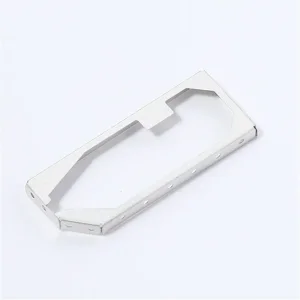
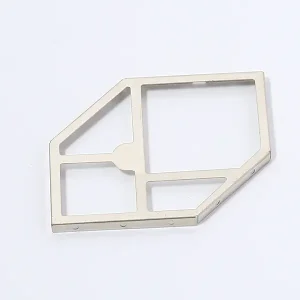
In high-density electronics design, board-level shielding is essential to mitigate Electromagnetic Interference (EMI) and Radio Frequency Interference (RFI). The main purpose of a through-hole shielding cover is to construct a Faraday cage around critical components. This isolates delicate analog circuits, high-speed microprocessors, and RF transceivers from noise. To meet these demands, Wenzhou Stpete Electronics Technology Co., Ltd. applies advanced material sciences and precise stamping techniques.
The performance of an EMI shield depends heavily on its material structure. For high-frequency shielding, we mainly use Alloy 770 (commonly called Nickel Silver), Tin-Plated Cold Rolled Steel (SPCC), and Tin-Plated Brass. Nickel Silver is highly valued for its natural corrosion resistance, excellent solderability without pre-plating, and shielding effectiveness across wide frequency ranges. For applications requiring lower costs, Tin-Plated Steel offers strong magnetic shielding at lower frequencies due to its high relative permeability.

Through-hole technology (THT) continues to be vital for board-level shielding, especially in environments subject to thermal cycling, high vibration, or mechanical shock. The metal pins of through-hole shielding covers extend through the PCB and are soldered from the underside, providing superior mechanical anchorage compared to surface-mount technology (SMT). This physical robustness prevents the shield from detaching under mechanical stress, ensuring continuous electrical grounding over the system's lifetime.
As the global electronics industry moves toward sub-6GHz, 5G, and emerging 6G systems, board-level shielding faces new challenges. Miniaturization requires shielding structures that can isolate multi-band transceivers placed close together on a single board. To address this, Stpete Electronics is developing Multi-Cavity Shielding Enclosures. These designs utilize internal partitions to isolate separate sections of a single PCB, saving space and weight.
Developing shielding structures optimized for higher frequencies up to 40 GHz, featuring engineered ventilation holes that prevent radiation leakage.
Integrating high-conductivity Thermal Interface Materials (TIMs) inside the shield to allow heat dissipation from active chips directly through the metal cover.
Employing inline optical coplanarity sensors to ensure all through-hole pins are flat within a <0.08mm tolerance, optimizing wave-soldering processes.
Furthermore, the integration of Through-Hole Reflow (THR) or Pin-in-Paste (PiP) processes represents a significant trend. Rather than using separate wave-soldering lines, modern assembly plants apply solder paste over plated through-holes, place the through-hole shield automatically using SMT pick-and-place nozzles, and run the assembly through a reflow oven. This hybrid approach combines the mechanical strength of THT with the high manufacturing speed of SMT.
Different application areas require distinct performance standards for through-hole shielding covers. As a global exporter, Wenzhou Stpete Electronics designs custom solutions to meet these industry-specific requirements:
High-speed routers, optical switches, and base stations handle immense data volumes and operate at gigahertz frequencies. Stpete provides multi-chamber shielding covers that prevent crosstalk between high-speed differential signal lanes and optical transceivers.
Advanced Driver Assistance Systems (ADAS), lidar sensors, and EV powertrains require high mechanical durability. Our through-hole shields feature reinforced mounting pins that withstand severe vehicle vibrations and thermal shock, meeting automotive standards.
Factory floors are subject to electromagnetic noise from heavy machinery, VFDs, and motors. Our thick-gauge shielding covers provide physical protection and low-impedance grounding, ensuring stable PLC and sensor operations.
Medical imaging and diagnostics equipment require high signal purity. Stpete designs custom non-magnetic copper alloy shields that provide high attenuation levels while preventing magnetic field distortion.
Wenzhou Stpete Electronics Technology Co., Ltd., founded in 2005, operates a modern manufacturing facility structured around high-speed stamping and automated assembly. With over 20 years of experience, we have built a fully integrated supply chain that handles every step from tool design and raw material sourcing to stamping, plating, and final inspection.
We operate precision stamping machines and CNC equipment, allowing us to maintain tight tolerances and ensure clean, burr-free cuts. To guarantee component reliability, our factory employs systematic quality inspections at each production phase. Our incoming materials undergo spectroscopic inspection, and finished products are verified via Automated Optical Inspection (AOI) systems. This rigorous QC process has enabled partnerships with leading global brands, including Huawei and Hisense.

Our engineering capabilities allow us to build custom stamping tools in-house. This capability speeds up the prototyping cycle for OEM customers, letting us deliver test samples in a short timeframe. Stpete holds certifications for ISO 9001:2015, ISO 14001:2015, and ISO 45001/18001, verifying our commitment to international quality, environmental responsibility, and workplace safety standards.
Sourcing electronic components globally requires careful management of international trade regulations, environmental standards, and quality frameworks. Modern procurement departments need components that comply with global environmental directives to avoid supply chain disruptions.
All Stpete through-hole shielding covers are certified to meet RoHS (Restriction of Hazardous Substances) and REACH (Registration, Evaluation, Authorization and Restriction of Chemicals) directives. We source raw materials from verified suppliers who provide material test reports and conflict-free mineral certifications. This ensures our components comply with environmental requirements in regions like North America, Europe, and the Asia-Pacific.

To support high-volume, global assembly lines, we package components in tape-and-reel or tray formats designed for automatic pick-and-place systems. Our logistics team coordinates with international carriers to provide flexible shipping options, including sea, air, and rail freight. This ensures timely delivery to OEM assembly plants worldwide.
Through-hole shielding covers offer much stronger mechanical anchoring to the PCB than SMT models. This makes them ideal for environments subject to high vibration, mechanical impact, or thermal expansion stresses. Solder joints that extend through the board also provide a reliable, low-impedance ground path, which is critical for shielding effectiveness.
For high-frequency applications (above 1 GHz), Alloy 770 (Nickel Silver) is often the preferred choice. It provides strong shielding performance and naturally resists corrosion without requiring post-plating, ensuring clean electrical contacts. For lower-frequency magnetic shielding, tin-plated cold-rolled steel is typically selected due to its higher magnetic permeability.
Ventilation holes allow air circulation and heat dissipation from components under the shield. However, to prevent EMI leakage, the diameter of these holes should be smaller than 1/20 of the wavelength of the target interference frequency. Keeping holes small ensures the cover behaves as a continuous conductive barrier.
We design and manufacture our stamping dies in-house to maintain strict tool tolerances. During production, we use high-speed automated progressive dies and integrate laser measurement systems to monitor pin alignment and coplanarity, keeping variances below 0.08mm.
Yes, we specialize in custom multi-cavity shielding covers. We can stamp internal dividing walls into a single cover structure, allowing a single component to isolate multiple circuits on the PCB. This design approach saves board space and simplifies assembly.
 Stpete Electronics